For many American children, financial education rarely goes much deeper than counting coins or solving word problems about apples and allowance money. “Schools just aren’t teaching these concepts in any structured way,” says Sonia Nagala Chang (MBA 2012). She discovered this “clear, universal gap” when her own three children, now 6, 8, and 10, started asking questions about money: “Kids are curious, but they aren’t learning decision-making or building good early money habits.”
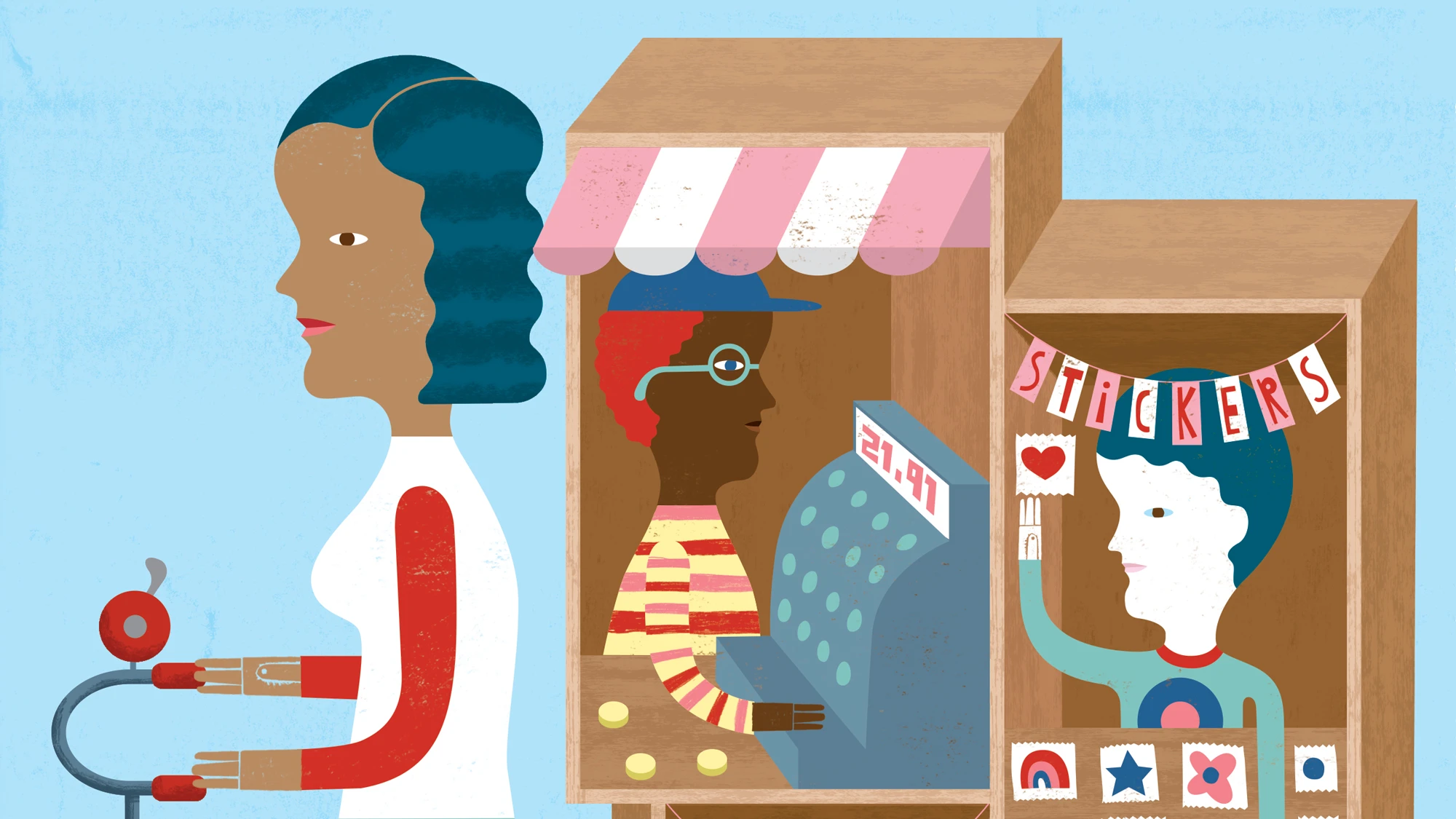
Chang’s solution is Mini Maker Academy, which offers a set of game-based programs for elementary and middle school kids that build financial literacy, investing, and entrepreneurship skills. The centerpiece of each is a simulated marketplace, complete with play money, painted storefronts, and inventory kits stocked with items like squishy toys, bouncy balls, and stickers. Students learn to set prices, manage inventory, invest profits, and handle the trade-offs that come with launching their own ventures. “They’re not just learning definitions, they’re making real financial decisions,” Chang says.
Chang founded Mini Maker in 2025 and has self-funded it to date, as it serves classrooms around the San Francisco Bay Area. A former COO of the online learning platform wikiHow, Chang believes the market is poised to scale quickly. “We’re seeing strong demand from parents and schools,” she says, noting that all of its partner sites, which include public and private schools as well as after-school centers, signed up for a second year. While Mini Maker’s target audience may be a decade or more away from taking out auto loans and contributing to 401(k)s, Chang says it’s never too early to start instilling money sense: “My ultimate goal is to make financial literacy a natural part of childhood education.

Family Business
Chang, who has a background in product management, approached this startup with the user experience in mind. Her first focus group was her own children. “Being a parent, you see what works for kids, and I got such immediate and helpful feedback,” she says.
IRL
“I probably looked a little bit ridiculous when I taught some of the earliest Mini Maker classes,” Chang says. “I was carrying this big cart with giant storefronts that I’d designed, coming in with real coins and boxes of inventory for the shops.” Screen-based activities would have been easier from an implementation perspective, she admits—and online or AI-based educational programs are certainly trendier in 2026. “But for younger learners, the hands-on component has been especially powerful,” Chang says. “This is tactile and interactive, and it’s sticky. Kids just want to keep coming back.”
Strategic Insights
Teaching Mini Maker classes in different neighborhoods has given Chang an appreciation for how a child’s background might influence how he or she thinks about money. “Some kids were planning ahead, saving their money, and then other kids were spending right away and spending everything,” she says. “Giving kids a chance to practice these decisions early on can have an impact in shifting those patterns.”