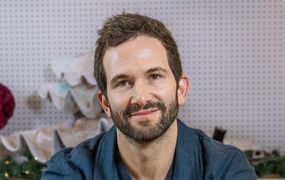
Avtar Hari Singh Khalsa (MBA '69)
Classmates may remember Khalsa as
Arthur S. Warshaw, MIT graduate and Baker Scholar. "No one is more
surprised than I when I look in the mirror," he remarks on his inner and
outer transformation. Khalsa embraced the Sikh faith, which originated
in India 550 years ago, after meeting Yogi Bhajan, the spiritual leader
who brought Sikhism to the West in 1969. "Eleven years ago, I began to
spend time with Sikhs in California and to practice their lifestyle, and
I eventually made the leap to wearing the white garments that remind us
of our commitment to living our spirituality daily," he says. The former
real-estate developer and president of Time-Life Television is now CEO
of Sun & Son, a computer consulting firm devoted to enabling
21st-century businesses to communicate and share information in new
ways. "I believe such technologies will lead to ever-increasing global
understanding and trust - truly spiritual principles," Khalsa says.
photo courtesy Avtar Hari Singh Khalsa
BACK TO MAIN ARTICLE
|
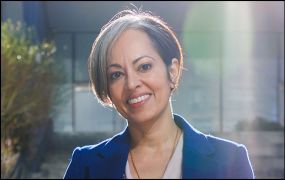
Jennifer Faith Lawrence (MBA '87)
"At the so-called peak of my career
I had a fancy title, lots of people reporting to me, a big office, lots
of money-and I was totally miserable," says Jennifer Lawrence, a savvy
executive who was named head of marketing for the Rockport Company shoe
firm at age 32. "I realized I didn't want to be living on an airplane
and treating people as though my needs were more important than theirs.
I wanted to change my life," she says. After a period of reflection and
working with a career counselor, she was invited to guest lecture at
Boston University. "I knew I was meant to teach," says Lawrence, who is
now a marketing professor at BU. She also consults to clients with
"knotty, interesting marketing problems." Her dream? "To open a complete
coaching getaway, called Renewal Lodge, where people can find the best
parts of themselves again."
photo by Sarah Putnam
BACK TO MAIN ARTICLE
|
Alonzo L. McDonald, Jr. (MBA '56)
Al McDonald has excelled at
leadership in the worlds of business, government, and education. A
former top executive at McKinsey and Bendix, between 1977 and 1981
McDonald was an ambassador, an assistant to President Jimmy Carter, and
a White House staff director. "I had a view of the pinnacle of earthly
power," he says, "and yet all I could see was frustration. I began to
realize there's a greater power at work in society than we humans
possess even in our most influential posts. So I started thinking,
reading, and trying to discover for myself the deeper meaning of life
and what my Creator wants for me." Today, McDonald spends much of his
time supporting various ministry activities and participating in
discussions at the Trinity Forum, an institute he cofounded to prompt
spiritual dialogue among secular leaders. "I've always been a hard-nosed
business guy," he says. "I'm sure lots of my old friends come to the
Trinity Forum just to see what's come over me!"
photo courtesy Alonzo L. McDonald, Jr.
BACK TO MAIN ARTICLE
|
James M. Stuart (MBA '69)
In the late 1800s, Jim Stuart's
great-grandfather founded the Quaker Oats Company with "integrity" and
"trustworthy" as part of its motto. Today, those words are more than a
marketing strategy for the fourth-generation Stuart-they have come to
form the core of his life quest. "The real question that has fascinated
me is, How do you develop those two values within an organization at the
end of the twentieth century?" says Stuart, who served in various
managerial capacities for Quaker Oats from 1969 to 1985. "I was known as
'the Prussian General' by my HBS friends because I was a big, powerful,
fearless guy," he recalls. "I always commanded from the head of the
table, shouting, 'This is not a democracy!' Then a series of personal
tragedies and professional smashings made me seriously reassess my life
and mature spiritually. I'm much gentler and happier now." Stuart
teaches marketing at the University of South Florida.
photo courtesy James Stuart
BACK TO MAIN ARTICLE
|
Richard C. Whiteley (MBA '68)
"About twenty years ago the death of my
parents and a divorce, in rapid succession, set me on a journey to
answer the question, Who am I?" says Richard Whiteley. "I discovered
that my life purpose is to bring spirit back into business through my
writing, speaking, and consulting and to keep working on my own personal
growth." An internationally acclaimed speaker and author of the
award-winning, best-selling books The Customer-Driven Company and
Customer-Centered Growth, Whiteley's recent writing explores "how to
free the individual so that when people come to work, all parts of them
show up-not just their hands or their head but their heart, spirit, and
soul." "Everyone has something unique, some outstanding quality that is
special," he says. "It's part of the leader's job to discover the genius
in each employee and create an environment in which that can flourish."
photo by Rick Friedman
BACK TO MAIN ARTICLE
|
Peter B. Vaill (MBA '60, DBA '64)
"My HBS classmates would probably
remember me as the guy who worried more about the philosophical issues
of the cases than whether we could get market share up another tenth of
a percent," Peter Vaill laughs. His interest in the people side of
business led him to become one of the pioneers in the "organizational
excellence" movement in the early 1970s. Cited in some circles as one of
the country's top ten organizational development specialists, Vaill is
lately known for his ideas on what he's termed "permanent white water"
-the turbulent social and organizational conditions that managerial
leaders face today. Now he is helping to lead the dialogue on the
"respiriting" of the workplace. "Divorces, job changes, and the cold
wind of personal mortality blowing on my neck have all fed into my
interest in issues of personal meaning in relationship to work," Vaill
notes.
photo courtesy Peter Vaill
BACK TO MAIN ARTICLE
|