![]()
In May, the School's annual Alumni Achievement Award was conferred upon six alumni, while two faculty members received the HBS Distinguished Service Award. Profiles of the honorees follow.
Ralph M. Barford
Frank Batten
David J. Dunn
Ann M. Fudge
Ellen R. Marram
Robert F. McDermott
Martin V. Marshall
Arthur N. Turner
President and CEO, Tropicana Beverage Group
Executive Vice President,The Seagram Company Ltd.
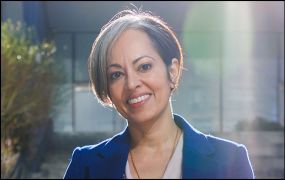
During Ellen Marram's distinguished 28-year career in the packaged-goods industry, "growth" has always been the operative word. Whether she has focused on growing profits, expanding businesses, or developing employees, this energetic executive with innovative ideas and excellent instincts has demonstrated a knack for revitalizing the old and cultivating the new. Assuming leadership of Seagram-owned Tropicana in 1993, Marram presided over an organizational restructuring that has earned the unit worldwide sales of more than $2 billion and double-digit quarterly profit increases for the past three years. In addition to traveling the globe looking for ways to produce and market an array of Tropicana juices, as well as expand Seagram's nonalcoholic and low-alcohol beverage business, she spends long days in her Park Avenue office attending to corporate and strategic matters.
Under Marram's leadership, the company has attained a prominent position in the worldwide premium juice business. Her skill in promoting growth without losing sight of her company's core competencies has put Tropicana on solid footing. (As the Bulletin went to press, Seagram announced it had agreed to sell Tropicana to Pepsico, Inc. for over $3 billion. Asked by Pepsico to stay on, Marram had not yet made her plans public.)
One of Business Week's "Top 25 Managers" of 1998, Marram graduated from Wellesley College in 1968 with a degree in economics and immediately went on to HBS at a time when few women were considering business school. Driven by a desire "to run a business of some kind" and discerning that one route to upper-level management was through consumer packaged-goods marketing, she took a position at Lever Brothers after earning her MBA.
Marram moved to Johnson & Johnson in 1973 and in 1977 joined Standard Brands Incorporated. There she rose to become vice president of marketing for the margarine division. Standard merged with Nabisco in 1981, and in 1987 she was named president of Nabisco's grocery division. Earning a reputation as a visionary executive, she was promoted in 1988 to president of the Nabisco Biscuit Company, the largest operating unit of the Nabisco Foods Group.
It was at Nabisco that Marram's creative business sense came into full bloom. In 1989, the first year after the widely publicized LBO of parent company RJR Nabisco, she increased Nabisco Biscuit's profits by more than 50 percent. Astutely observing the public's growing concern about nutrition and health, she then led the 1992 launch of SnackWell's line of cookies and crackers, which pioneered low-fat snacking and became one of the most successful new products of the 1990s.
Not surprisingly, Marram's advice is sought by a number of other organizations, too. She serves on the boards of the Ford Motor Company, The New York and Presbyterian Hospital, Lincoln Center Theater, The Conference Board, and the Advertising Council, and she was recently elected a director of the New York Times Company.
RETURN TO THE TOP OF THE PAGE
Brigadier General, U.S. Air Force (Retired)
Chairman Emeritus, USAA
In 1993, after a 25-year tenure at the United Services Automobile Association (USAA), General Robert McDermott stepped down from the helm of this highly diversified insurance conglomerate. He left a legacy of openness to new technologies, a commitment to employee training, and a collaborative style of leadership that had transformed the company.
His success at USAA followed an equally impressive and lengthy military career. At 39 he was appointed general, thus becoming the youngest person in the armed forces to attain that rank at the time. In 1958 he was named the first permanent academic dean of the U.S. Air Force Academy, where his decade of service was characterized byquality and innovation.
When McDermott first joined USAA, the company was a respected but relatively unknown organization with assets of $200 million. The firm was drowning in paperwork, and its employee turnover rate was 43 percent. McDermott changed all that, successfully diversifying USAA into areas such as mutual funds, banking, and credit cards; building assets to some $30 billion; and reducing employee turnover to 7 percent. Fortune magazine consistently ranked USAA first among the country's most admired insurers.
Upon retirement, McDermott, summarizing his philosophy, asserted that success had flowed from his application of the Golden Rule to the world of business: "Serve others as you would have them serve you." When he announced his plans to step down, McDermott reminded his colleagues, "We've made customer service our primary goal, and we've encouraged other corporations to do the same." A year later, he was named to the National Business Hall of Fame.
A native of the Boston area who graduated from West Point in 1943, McDermott became a fighter-bomber pilot in World War II. He then served on General Dwight D. Eisenhower's staff before being sent to HBS to learn the management skills needed to meet the postwar challenge of modernizing the military.
With MBA in hand in 1950, McDermott returned to West Point to teach economics. In an environment that valued conformity, he introduced assignments in his courses that appealed to each cadet's strengths and interests. In 1954 he began to apply this approach on a larger scale at the newly founded Air Force Academy, enriching the curriculum by introducing academic majors, electives, and master's degree programs in conjunction with graduate schools at leading civilian institutions. As the other service academies gradually began to adopt these changes, he was hailed as "the father of modern military education."
McDermott hasn't slowed down in retirement, concentrating his energy and vision on an array of community-related projects. Among them is the Texas Research and Technology Foundation, which he established in 1984 to develop San Antonio's Texas Research Park, now a center for biotechnology research. He is also active in efforts to reform public education through the Texas Public Policy Foundation, an organization he cofounded several years ago and now chairs.
RETURN TO THE TOP OF THE PAGE